
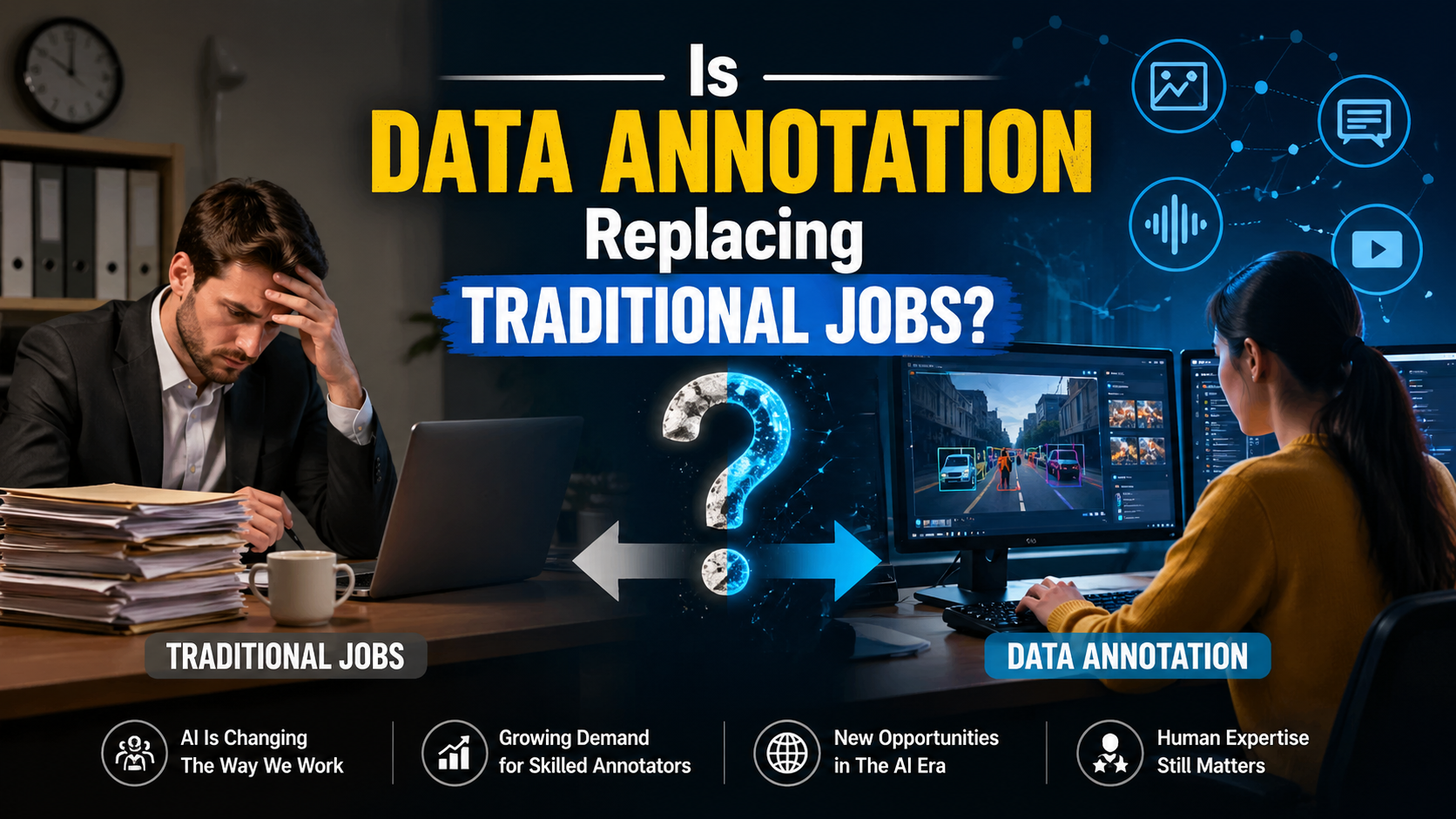
Artificial Intelligence is no longer a futuristic concept—it’s shaping the way businesses operate today. From self-driving cars to voice assistants and recommendation systems, AI is deeply embedded in modern life. But behind every intelligent system lies a less-discussed yet critical process: data annotation.
As demand for AI continues to surge, a pressing question emerges: Is data annotation replacing traditional jobs, or is it creating new opportunities?
Understanding Data Annotation
Data annotation is the process of labeling data—text, images, audio, or video—so that machine learning models can understand and learn from it. For example:
- Tagging objects in images for computer vision
- Labeling sentiments in text for natural language processing
- Transcribing speech for voice recognition systems
Without annotated data, AI systems simply cannot function effectively.
The Shift from Traditional Jobs
Automation and AI have already transformed many industries. Tasks that were once manual—like data entry, customer support, and quality inspection—are increasingly handled by machines. Naturally, this has raised concerns about job displacement.
However, data annotation presents an interesting twist in this narrative.
1. Not Replacement, But Transformation
Rather than completely replacing traditional jobs, data annotation is reshaping them. Roles that once required repetitive manual work are evolving into more specialized tasks involving:
- Data labeling
- Quality control
- AI training support
For example, a traditional data entry operator may now work as a data annotator, contributing directly to AI development.
The Rise of New Job Opportunities
Instead of eliminating jobs, data annotation is creating entirely new categories of employment.
2. Accessible Entry-Level Opportunities
Data annotation requires minimal barriers to entry compared to many tech roles. This makes it an attractive option for:
- Students
- Freelancers
- Remote workers
- Career switchers
Many people who previously worked in non-technical roles are now finding opportunities in AI-related work through annotation.
3. Growth of Remote Work
One of the biggest advantages of data annotation is flexibility. Most annotation tasks can be performed remotely, enabling global participation. This has opened doors for workers in regions where traditional job opportunities may be limited.
Challenges and Concerns
While data annotation offers opportunities, it also comes with its own set of challenges.
4. Repetitive Nature of Work
Some annotation tasks can be monotonous, especially at scale. This can lead to fatigue and reduced job satisfaction if not managed properly.
5. Quality vs Speed Pressure
High-quality annotation is crucial for AI accuracy. However, workers are often expected to balance speed with precision, which can be demanding.
6. Job Stability Questions
Many annotation roles are project-based or freelance, raising concerns about long-term job security compared to traditional employment.
The Bigger Picture: Human + AI Collaboration
The idea that AI will completely replace humans is often overstated. In reality, AI depends heavily on human input, especially in the training phase.
Data annotation is a perfect example of human-in-the-loop systems, where:
- Humans provide context and understanding
- Machines scale and automate processes
This collaboration ensures better outcomes and creates a symbiotic relationship rather than a competitive one.
Industry Demand Is Booming
As AI adoption accelerates across industries like healthcare, finance, retail, and autonomous systems, the demand for high-quality annotated data continues to grow.
Organizations are increasingly outsourcing data annotation to specialized service providers to ensure:
- Accuracy
- Scalability
- Cost efficiency
This trend highlights that data annotation is not just a temporary role—it’s becoming a foundational part of the AI ecosystem.
So, Is Data Annotation Replacing Traditional Jobs?
The answer is nuanced.
Data annotation is not directly replacing traditional jobs. Instead, it is:
- Transforming existing roles
- Creating new employment opportunities
- Supporting the growth of AI-driven industries
Rather than a threat, it represents a shift in how work is structured in the digital age.
How Businesses Are Adapting
To stay competitive, companies are increasingly investing in reliable data annotation services. High-quality labeled data is the backbone of any successful AI model, and businesses cannot afford inaccuracies.
If you’re looking to leverage expert-driven annotation solutions, professional services can help streamline your AI workflows and ensure top-tier results.
At Knotra Global, we specialize in delivering scalable and precise data annotation solutions tailored to diverse industries. Whether you’re building machine learning models or enhancing AI performance, our team ensures high-quality outputs that drive real impact. Learn more about our services here:
👉 https://knotraglobal.com/
Additionally, for businesses seeking comprehensive outsourcing solutions, explore:
👉 https://www.oursglobal.com/outsource-data-annotation-labelling-services
These services are designed to help organizations efficiently manage large-scale data annotation projects while maintaining accuracy and consistency.
Final Thoughts
Data annotation is not the end of traditional jobs—it’s the beginning of a new era of work. As AI continues to evolve, so will the roles that support it.
The key lies in adaptability. Those who embrace emerging opportunities like data annotation will not only stay relevant but thrive in the AI-driven future.

Ravi, IT & Marketing Director at KnoTra Global, blends 16+ years of IT and marketing expertise to drive innovation in cybersecurity, cloud, and IT support.