
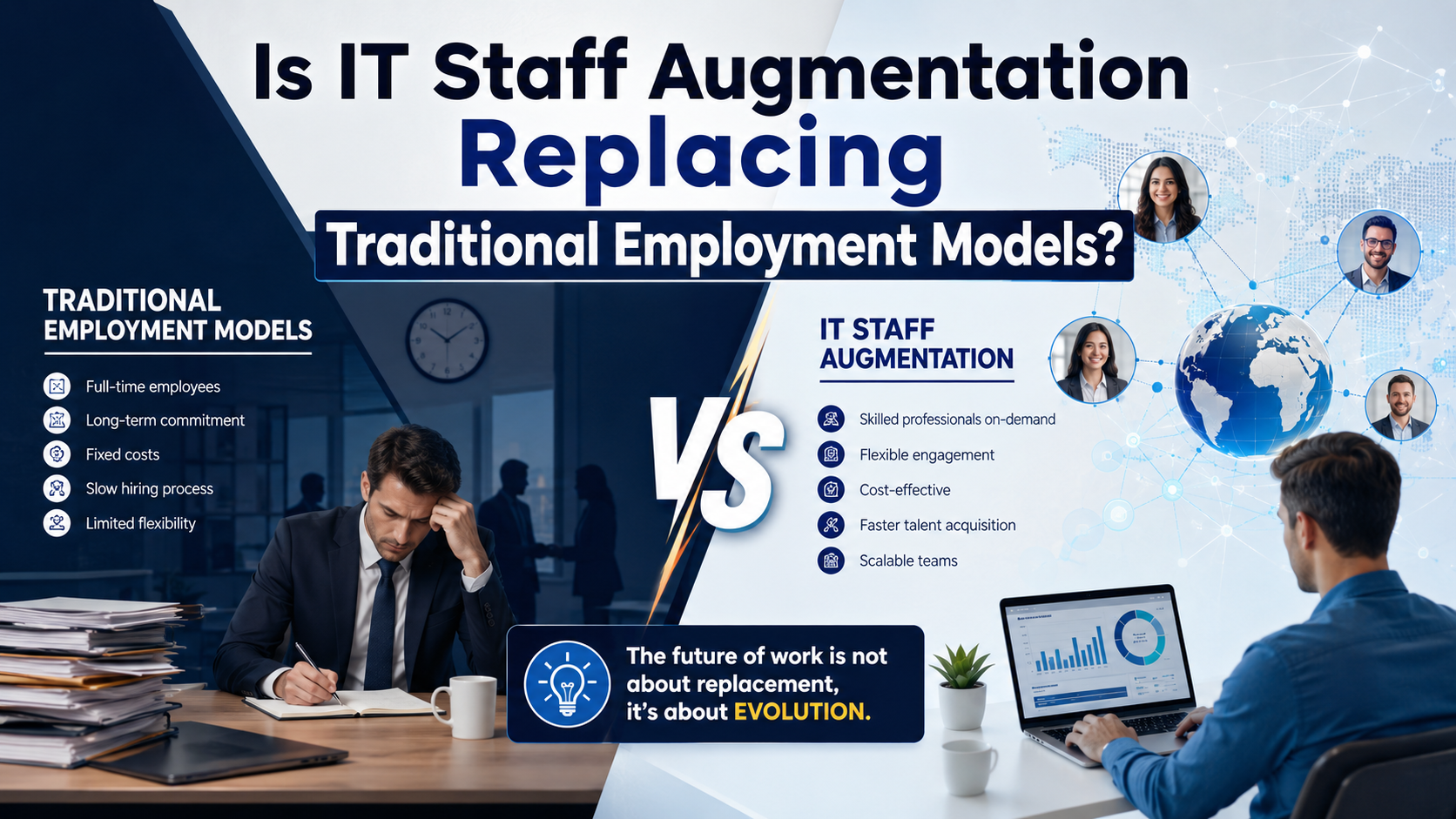
The workplace is undergoing one of the biggest transformations in modern business history. Companies that once relied entirely on full-time, in-house employees are now embracing more flexible workforce structures. Digital transformation, remote collaboration, global talent shortages, and rapidly changing technologies have pushed organizations to rethink traditional hiring models.
At the center of this shift is IT Staff Augmentation — a hiring strategy that allows businesses to extend their technical teams using external specialists without the long-term commitment of permanent employment.
Many business leaders are now asking a critical question:
Is IT Staff Augmentation replacing traditional employment models, or is it simply evolving the way companies build teams?
The answer is complex. IT Staff Augmentation is not completely eliminating traditional employment, but it is fundamentally changing how modern organizations hire, scale, and manage talent.
Companies today no longer compete only through products or services. They compete through speed, innovation, adaptability, and access to specialized expertise. Traditional hiring methods often struggle to keep pace with these demands. As a result, businesses are increasingly turning toward flexible workforce solutions that allow them to scale quickly and remain competitive in fast-moving industries.
Organizations seeking scalable technology teams often explore solutions such as Knotra Global IT Staff Augmentation Services to access specialized developers, engineers, and technical professionals without the delays associated with conventional recruitment.
The Evolution of Traditional Employment
For decades, traditional employment was considered the ideal workforce model. Companies hired full-time employees, invested in long-term training, built internal departments, and developed organizational loyalty over time.
This model worked effectively in industries where:
- Technology evolved slowly
- Workforce requirements remained stable
- Long-term employment was common
- Specialized skills were easier to find
Traditional hiring provided businesses with:
- Stability
- Cultural consistency
- Internal knowledge retention
- Structured career growth
- Long-term operational control
However, the digital economy changed these assumptions.
Modern businesses now operate in environments where technologies evolve every few months. New programming frameworks, AI systems, cybersecurity threats, cloud infrastructures, and automation tools continuously reshape the technology landscape.
Hiring permanent employees for every emerging skill is no longer practical for many organizations.
What Is IT Staff Augmentation?
IT Staff Augmentation is a workforce strategy where companies hire external IT professionals to work alongside internal teams on temporary, project-based, or long-term assignments.
Unlike traditional outsourcing, staff augmentation allows businesses to maintain direct control over projects, workflows, communication, and product development while gaining rapid access to specialized expertise.
This model helps companies:
- Fill immediate skill gaps
- Accelerate software development
- Reduce hiring delays
- Scale teams quickly
- Access global technical talent
- Support short-term or specialized projects
Modern businesses increasingly rely on augmentation models because they provide flexibility without sacrificing operational control.
Companies exploring scalable development solutions often review providers like Knotra Global for flexible engineering support and project-based staffing solutions.
Why Traditional Hiring Is Losing Momentum
1. The Technology Skills Gap
One of the biggest challenges facing businesses today is the shortage of highly skilled IT professionals.
The demand for experts in:
- Artificial Intelligence
- Cloud Computing
- DevOps
- Cybersecurity
- Data Engineering
- Blockchain
- Machine Learning
continues to grow faster than the available talent pool.
Traditional hiring processes often fail because:
- Recruitment cycles are too slow
- Specialized professionals are difficult to find
- Salary expectations continue to rise
- Employee retention is becoming harder
Businesses can spend months searching for a single senior developer while projects remain delayed.
IT Staff Augmentation solves this issue by giving organizations faster access to experienced professionals who are already trained and ready to contribute immediately.
2. Business Agility Has Become Essential
In the digital economy, speed matters.
Companies launching SaaS platforms, mobile apps, enterprise systems, or AI-driven products cannot afford slow hiring cycles.
Traditional recruitment typically involves:
- Job advertisements
- Resume screening
- Multiple interviews
- Technical assessments
- Salary negotiations
- Notice periods
- Employee onboarding
This process may take several months.
By contrast, staff augmentation allows businesses to onboard professionals within days or weeks.
This flexibility enables organizations to:
- Launch products faster
- Meet tight deadlines
- Handle sudden workload increases
- Respond quickly to market opportunities
Agility is no longer optional — it has become a competitive advantage.
3. The Cost Structure of Traditional Employment Is Increasing
Permanent employment comes with significant long-term expenses beyond salaries.
Businesses must manage:
- Recruitment costs
- Employee benefits
- Insurance
- Infrastructure
- Training
- Paid leave
- Retention programs
- Office expenses
During uncertain economic conditions, maintaining large in-house teams can become financially difficult.
IT Staff Augmentation offers a more flexible cost model.
Organizations can:
- Pay only for required expertise
- Scale teams up or down as needed
- Avoid long-term financial liabilities
- Optimize operational spending
For startups and growing enterprises, this flexibility can be the difference between scaling successfully and overspending.
4. Remote Work Changed Workforce Expectations
Remote work transformed how companies think about hiring.
Businesses now understand that high-performing teams do not need to operate from a single office location.
As remote collaboration became normalized, companies gained confidence in:
- Distributed engineering teams
- Offshore developers
- Global technical collaboration
- Remote project management
This shift accelerated the growth of IT Staff Augmentation because businesses became more comfortable integrating external professionals into daily operations.
The modern workforce is no longer restricted by geography.
IT Staff Augmentation vs Traditional Employment
| Workforce Factor | Traditional Employment | IT Staff Augmentation |
|---|---|---|
| Hiring Speed | Slow | Fast |
| Workforce Flexibility | Limited | Highly Flexible |
| Long-Term Commitment | Required | Optional |
| Access to Specialized Skills | Moderate | Extensive |
| Scalability | Difficult | Easy |
| Cost Efficiency | Lower | Higher |
| Workforce Stability | Strong | Variable |
| Project Adaptability | Moderate | High |
| Recruitment Risk | High | Reduced |
This comparison explains why many organizations are integrating augmentation strategies into their workforce planning.
Is IT Staff Augmentation Replacing Full-Time Jobs?
The reality is more balanced than many headlines suggest.
IT Staff Augmentation is not completely replacing traditional employment. Instead, businesses are moving toward hybrid workforce models that combine:
- Permanent employees
- Augmented specialists
- Freelancers
- Consultants
- Outsourced teams
Full-time employees still play a critical role in:
- Leadership
- Strategic planning
- Company culture
- Product ownership
- Long-term business continuity
However, staff augmentation is becoming the preferred solution for:
- Specialized technical projects
- Temporary scaling
- Emerging technologies
- Digital transformation initiatives
- Rapid development cycles
The future of work is likely to be hybrid rather than fully traditional or fully outsourced.
Why Startups Prefer IT Staff Augmentation
Startups face unique challenges:
- Limited budgets
- Rapid growth requirements
- Tight product deadlines
- Constant technological change
Hiring large permanent teams early can create financial pressure.
IT Staff Augmentation helps startups:
- Build MVPs faster
- Access senior developers
- Scale engineering teams gradually
- Reduce hiring risks
- Focus capital on growth
This flexibility allows startups to remain lean while still accessing world-class expertise.
How Enterprises Use Staff Augmentation Strategically
Large enterprises are also embracing augmentation models.
Many corporations use external specialists for:
- Cloud migration projects
- Cybersecurity initiatives
- ERP implementations
- AI integration
- Legacy system modernization
- Enterprise application development
Enterprises often maintain strong internal teams while augmenting specific skill sets temporarily.
This approach increases operational efficiency without permanently expanding workforce size.
The Hidden Advantages of IT Staff Augmentation
Faster Innovation
External specialists often bring experience from multiple industries and projects, introducing fresh ideas and advanced technical knowledge.
Reduced Burnout
Internal teams can avoid excessive workloads during high-pressure projects.
Better Project Focus
Businesses can quickly assemble highly specialized teams tailored to specific objectives.
Lower Recruitment Risk
Organizations avoid expensive hiring mistakes associated with permanent recruitment.
Access to Global Talent
Companies are no longer restricted to local hiring markets.
Challenges of IT Staff Augmentation
Although highly beneficial, staff augmentation also presents challenges.
Communication Complexity
Managing distributed teams requires strong collaboration systems.
Data Security Risks
External professionals may access sensitive systems or company information.
Team Integration Issues
Temporary staff may require additional onboarding and alignment.
Dependency on External Talent
Over-reliance on external professionals can create operational risks if not managed carefully.
Successful organizations address these challenges through:
- Clear workflows
- Secure systems
- Effective project management
- Strong communication practices
Businesses often work with experienced providers like Knotra Global to ensure smoother team integration and workforce scalability.
The Future of Employment Models
The future workforce will likely become increasingly flexible.
Businesses are moving toward:
- Hybrid workforce ecosystems
- Project-based staffing
- Remote-first collaboration
- Skill-based hiring
- Global talent networks
Companies no longer prioritize workforce size alone. Instead, they prioritize adaptability, speed, and specialized expertise.
Traditional employment models will continue to exist, but they will coexist with more flexible staffing strategies.
Organizations that fail to adapt may struggle to compete in industries driven by rapid technological change.
Why IT Staff Augmentation Is Growing Rapidly
Several long-term trends are accelerating adoption:
- Digital transformation
- AI implementation
- Global remote work
- Cloud computing growth
- Increased demand for specialized skills
- Rising hiring costs
As these trends continue, IT Staff Augmentation is expected to become a permanent part of modern workforce strategy.
Businesses increasingly recognize that workforce flexibility is no longer just a cost-saving tactic — it is a strategic advantage.
Final Thoughts
IT Staff Augmentation is not destroying traditional employment models, but it is reshaping them in profound ways.
The modern business environment demands agility, scalability, and rapid access to specialized expertise. Traditional hiring alone often cannot meet these demands efficiently.
As a result, companies are adopting hybrid workforce structures that combine the stability of permanent employees with the flexibility of augmented talent.
Full-time employees will remain essential for leadership, strategic continuity, and organizational culture. However, IT Staff Augmentation is becoming indispensable for businesses seeking innovation, speed, and operational flexibility.
The future of employment will not belong exclusively to traditional hiring or staff augmentation.
It will belong to organizations that successfully combine both models to build smarter, faster, and more adaptable teams.

Ravi, IT & Marketing Director at KnoTra Global, blends 16+ years of IT and marketing expertise to drive innovation in cybersecurity, cloud, and IT support.